Apollo Investigation
by Jack White
I have great admiration for many achievements of NASA. I admire the courage, dedication and sacrifice of the astronauts who died in their pursuits of new frontiers proposed by President John Kennedy in 1960 when he pledged to put a man on the Moon by the end of the decade. I am saddened by the deaths of the Columbia and Challenger scientists who trusted NASA with their lives. On my office television in 1986 I saw the live explosion of the Challenger. And I watched in horror that bright February morning as the space shuttle Columbia broke apart in a smoky trail over my Texas home in 2003. I am saddened by the deaths on a launchpad in Florida in 1967 of Apollo 1 astronauts Gus Grissom, Ed White and Roger Chaffee, who may have known too much for their own security.
I marvel at the achievement of the Hubble Space Telescope, which brings us dream world images from the infinity of outer space. And the images from Mars also help us understand our universe.
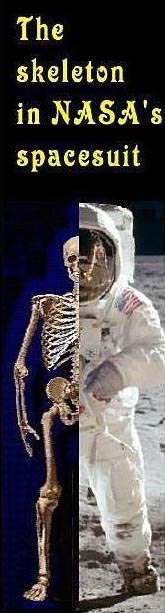
But the thousands of honorable workers at NASA will be shocked and saddened to learn of the dark secrets of forty years ago – the Apollo Moon missions. Examination of NASA records reveals a terrible skeleton rotting away in their own files, a monumental deception. Very few NASA employees knew about the ruse, although it continues to be covered up to this very day by some secret keeper of the "national security" keys. Most likely this was a TOP SECRET political/military project.
This skeleton in the NASA closet is documented by the space agency itself. And the facts provided are indisputable. As Shakespeare might have said, the agency is "hoist with their own petard" – that is, blown up by their own devices.
What is this dirty secret?
Grave doubt exists that the Apollo missions to the Moon were anything more than the most incredible hoax of all time. Did astronauts actually go to the Moon? I do not know. But NASA's own evidence shows that all photos of the Apollo feats had to be forgeries. They were likely made in a secret Earthly studio somewhere as a top secret military project. And if all the "Moon photos" of all the "Moon missions" were fakes, the question is 'why?'.
Real missions should have produced real photos.
To understand the "why" of faking "landing a man on the Moon by the end of the decade" that had been promised by JFK in his first speech to Congress, one must go back to the Cold War with the USSR and the much-touted "space race". In the early 60s, the Soviets were ahead of the US in space exploration. Sputnik and other Red successes evoked a US political crisis. But the Soviets likely knew that sending a man to the Moon was an immensely difficult task and that JFK's rhetoric was a hollow promise.
However, after Lyndon B. Johnson succeeded the assassinated Kennedy he likely came up with a brilliant (and evil, in my opinion) idea. He must have thought, "...the experts say we can't go to the Moon like Kennedy promised, but I say we can! We can FAKE IT!" If LBJ could pull it off, to simplify a very complex Cold War situation, it would be a great propaganda coup and establish US superiority over communism. So I theorize that LBJ conspired with his successor Richard M. Nixon and OTHERS to carry out an elaborate plan to fool the world by "flying to the Moon". It was a brilliant plan, executed in strict military secrecy, and it has fooled the world for more than 40 years. But it has been undone by its own excesses, as now revealed from NASA records for the first time.
Anyone with even elemental math skills and common sense can look at the facts, do the calculations, and come to their own conclusions about the alleged MASSIVE VOLUME of lunar surface photography in such a LIMITED TIME.
Here is my conclusion: IT COULD NOT BE DONE.
It boils down not to just studying the photographs for signs of fakery, though I have examined every available Apollo photo for more than three years (and discovered many fakes). Very simply, it amounts to a study known to many businesses...A TIME AND MOTION STUDY. The elementary question is: was it possible to take the known number of photos (from NASA records) in the amount of time available (from NASA records)? But before you read my study, to understand it you need to know some basic information about the Apollo missions:
1. Of seven Apollo missions to put "men on the Moon", six were claimed to be "successful". (Apollo 13 was "aborted".)
2. Each of the six successful missions landed two astronauts "on the Moon" in a flimsy craft NASA originally had called the Lunar Excursion Module (LEM, later shortened to LM), an unproven craft which never had an opportunity for a lunar landing test flight. But it landed and then took off six times with spectacular "success" on Apollo missions 11 and 12, and 14 through 17...once even landing within 200 feet of a pre-selected target.
3. Two astronauts rode each LEM to the Moon surface while one remained in the orbiting Command and Service Module (CSM) awaiting their return.
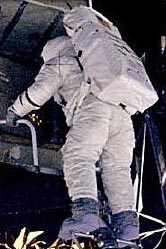
4. During their Extra-Vehicular Activity (lunar surface exploration) each of the two wore a bulky inflated spacesuit with clumsy gloves, greatly limiting mobility. On their backs they wore a huge and heavy Life Support System (PLSS) backpack containing an oxygen tank and circulating water air conditioning system which pumped refrigerated water throughout the suit to counteract the 200+/- degree heat (and cold) of lunar conditions. Pumps circulated both refrigerated air and water to the liquid cooling undergarment, as well as dehumidifying, removing carbon dioxide, and providing all other functions needed to survive harsh conditions in the confining suits.
5. The principal objective of all six missions was SCIENTIFIC RESEARCH projects to be carried out by the two astronauts. Most of the projects, which numbered about a half dozen each mission, were remarkably similar on all six missions. All of these science experiments involved unpacking equipment from stowage bays, assembling it, transporting it to its location, setting it up, and then doing the experiments. As you might imagine, each of these research projects would require a major portion of the TIME of the two men for each experiment.
6. Another major project besides operation of the packaged experiments was the Geological Study, which involved searching for different specimens of rocks and soils in various locations, documenting and collecting samples to return to earth. This obviously occupied much of their TIME.
7. Considerable TIME was needed for "housekeeping chores". After landing, the LEM had to be inspected to make sure it had not been damaged. Communications equipment to put them in contact with Earth had to be set up and operated, including radio and television antennas and TV cameras. The US flag was planted in the moondust on each mission. All of this was done before any experiments were initiated. Oh, and don't forget the "ceremonial" chat with President Nixon during Apollo 11.
8. The first three missions required the astronauts to walk to each experiment location. The last three missions were supplied with a Lunar Roving Vehicle (LRV) to travel to distant locations miles away from the LEM. The partially pre-assembled LRV was attached to the outside of the LEM. The rover floor served as a pallet which was hinged to the outside of the LRV. The wheels were folded under. The "pallet" was lowered by hand to the lunar surface, and the wheels rotated into position. After the wheels were down, the vehicle had to be outfitted with all of its considerable equipment from various storage bins of the LEM. Oddly, not a single photo exists in the public domain (at least that I could find to date) of the astronauts assembling and equipping the LRVs. The battery-powered rovers had a top speed of about 8 mph, only slightly faster than walking...much like a golf cart. During the LRV travels ("traverses"), both men rode, and when moving, had no opportunity for photography. Also, the time taken in assembling the rover was not used for any photography. Though I could find no time given by NASA, surely it is reasonable to guess that it took at least an hour to unload, assemble and equip and test a rover?
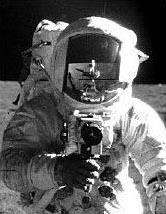
9. Almost incidental to the main astronaut tasks was PHOTOGRAPHY. Each astronaut had his own camera. (Apart from the Apollo 11 EVA.) It was a square-format specially-built Hasselblad. It was mounted on a chest-plate for the astronaut to operate. The astronaut had to manually set the shutter speed and apertures while wearing bulky, pressurized gloves and without being able to see the controls. The cameras had NO VIEWFINDER, so the astronaut could only guess at what was being photographed. Each camera had a bulk film magazine holding more than a hundred exposures. The film (mainly Ektachrome color film) had a very narrow exposure range, which required PERFECT aperture and shutter settings, because according to NASA, the cameras did not have automatic exposure capability.
10. It is important to know that although each man had his own camera, they ALMOST NEVER USED THEM AT THE SAME TIME. Usually one of them was photographing the other doing some task. Therefore having two cameras DID NOT TRANSLATE TO TWICE AS MUCH TIME FOR PHOTOGRAPHY, as one might surmise. Now that you understand the missions, here is my discovery of NASA overzealousness, which has been successfully hidden till now.
A TIME AND MOTION STUDY
For more than three years I have been collecting and analyzing nearly all the significant photos from the Apollo missions. These official photos are readily available on multiple NASA websites for downloading. Recently I noticed they were taking up many gigabytes of memory on my computer's external hard drive, so I began organizing them and deleting duplications. I did a rough estimate of the number of Apollo photos, and was amazed that I had thousands!
I visited several official NASA websites to find HOW MANY PHOTOS WERE TAKEN on the surface of the Moon. Amazingly, NASA AVOIDS THIS SUBJECT almost entirely. Two days of searching documents and text were fruitless. But Lunar Surface Journal, one of the sites, lists every photo with its file number. So I undertook to make an actual count of every photo taken by astronauts DURING EXTRA-VEHICULAR ACTIVITY (EVA), the time spent on the surface out of the LEM.
Here is my actual count of EVA photos of the six missions:
Apollo 11........... 121
Apollo 12........... 504
Apollo 14........... 374
Apollo 15..........1021
Apollo 16..........1765
Apollo 17..........1986
So 12 astronauts while on the Moon's surface took a TOTAL of 5771 exposures.
That seemed excessively large to me, considering that their TIME on the lunar surface was limited, and the astronauts had MANY OTHER TASKS OTHER THAN PHOTOGRAPHY. So I returned to the Lunar Surface Journal to find how much TIME was available to do all the scientific tasks AS WELL AS PHOTOGRAPHY. Unlike the number of photos, this information is readily available:
Apollo 11........1 EVA .....2 hours, 31 minutes......(151 minutes)
Apollo 12........2 EVAs.....7 hours, 50 minutes......(470 minutes)
Apollo 14........2 EVAs.....9 hours, 25 minutes......(565 minutes)
Apollo 15........3 EVAs...18 hours, 30 minutes....(1110 minutes)
Apollo 16........3 EVAs...20 hours, 14 minutes....(1214 minutes)
Apollo 17........3 EVAs...22 hours, 04 minutes....(1324 minutes)
Total minutes on the Moon amounted to 4834 minutes.
Total number of photographs taken was 5771 photos.
Hmmmmm. That amounts to 1.19 photos taken EVERY MINUTE of time on the Moon, REGARDLESS OF OTHER ACTIVITIES. (That requires the taking of ONE PHOTO EVERY 50 SECONDS!) Let's look at those other activities to see how much time should be deducted from available photo time:
Apollo 11....Inspect LEM for damage, deploy flag, unpack and deploy radio and television equipment, operate the TV camera (360 degree pan), establish contact with Earth (including ceremonial talk with President Nixon), unpack and deploy numerous experiment packages, find/document/collect 47.7 pounds of lunar rock samples, walk to various locations, conclude experiments, return to LEM.
Apollo 12....Inspect LEM for damage, deploy flag, unpack and deploy radio and television equipment (spend time trying to fix faulty TV camera), establish contact with Earth, unpack and deploy numerous experiment packages, walk to various locations, inspect the unmanned Surveyor 3 which had landed on the Moon in April 1967 and retrieve Surveyor parts. Deploy ALSEP package. Find/document/collect 75.7 pounds of rocks, conclude experiments, return to LEM.
Apollo 14....Inspect LEM for damage, deploy flag, unpack and deploy radio and television equipment and establish contact with Earth, unpack and assemble hand cart to transport rocks, unpack and deploy numerous experiment packages, walk to various locations. Find/document/collect 94.4 pounds of rocks, conclude experiments, return to LEM.
Apollo 15....Inspect LEM for damage, deploy flag, unpack and deploy radio and television equipment and establish contact with Earth, unpack/assemble/equip and test the LRV electric-powered 4-wheel drive car and drive it 17 miles, unpack and deploy numerous experiment packages (double the scientific payload of first three missions). Find/document/collect 169 pounds of rocks, conclude experiments, return to LEM. (The LRV travels only 8 mph*.)
Apollo 16....Inspect LEM for damage, deploy flag, unpack and deploy radio and television equipment and establish contact with Earth, unpack/assemble/equip and test the LRV electric-powered 4-wheel drive car and drive it 16 miles, unpack and deploy numerous experiment packages (double the scientific payload of first three missions, including new ultraviolet camera, operate the UV camera). Find/document/collect 208.3 pounds of rocks, conclude experiments, return to LEM. (The LRV travels only 8 mph*.)
Apollo 17....Inspect LEM for damage, deploy flag, unpack and deploy radio and television equipment and establish contact with Earth, unpack/assemble/equip and test the LRV electric-powered 4-wheel drive car and drive it 30.5 miles, unpack and deploy numerous experiment packages. Find/document/collect 243.1 pounds of rocks, conclude experiments, return to LEM. (The LRV travels only 8 mph*.)
Let's arbitrarily calculate a MINIMUM time for these tasks and subtract from available photo time:
Apollo 11...subtract 2 hours (120 mins), leaving 031 mins for taking photos
Apollo 12...subtract 4 hours (240 mins), leaving 230 mins for taking photos
Apollo 14...subtract 3 hours (180 mins), leaving 385 mins for taking photos
Apollo 15...subtract 6 hours (360 mins), leaving 750 mins for taking photos
Apollo 16...subtract 6 hours (360 mins), leaving 854 mins for taking photos
Apollo 17...subtract 8 hours (480 mins), leaving 844 mins for taking photos
So do the math:
Apollo 11.....121 photos in 031 minutes........3.90 photos per minute
Apollo 12.....504 photos in 230 minutes........2.19 photos per minute
Apollo 14.....374 photos in 385 minutes........0.97 photos per minute
Apollo 15...1021 photos in 750 minutes........1.36 photos per minute
Apollo 16...1765 photos in 854 minutes .......2.06 photos per minute
Apollo 17...1986 photos in 844 minutes .......2.35 photos per minute
Or, to put it more simply:
Apollo 11........one photo every 15 seconds
Apollo 12........one photo every 27 seconds
Apollo 14........one photo every 62 seconds
Apollo 15........one photo every 44 seconds
Apollo 16........one photo every 29 seconds
Apollo 17........one photo every 26 seconds
So you decide. Given all the facts, was it possible to take that many photos in so short a time?
Any professional photographer will tell you it cannot be done. Virtually every photo was a different scene or in a different place, requiring travel. As much as 30 miles travel was required to reach some of the photo sites. Extra care had to be taken shooting some stereo pairs and panoramas. Each picture was taken without a viewfinder, using manual camera settings, with no automatic metering, while wearing a bulky spacesuit and stiff clumsy gloves.
The agency wants the world to believe that 5771 photographs were taken in 4834 minutes! IF NOTHING BUT PHOTOGRAPHY HAD BEEN DONE, such a feat is clearly impossible...made even more so by all the documented activities of the astronauts. Imagine...1.19 photos every minute that men were on the Moon – that's one picture every 50 SECONDS!
The secret NASA tried to hide has been discovered: The quantity of photos purporting to record the Apollo lunar EVAs could not have been taken on the Moon in such an impossible time frame. So why do these photos exist? How did these photos get made? Did ANY men go to the Moon? Or was it truly the greatest hoax ever?
© 2005 Jack White
Editor's Notes: *According to Andrew Chaikin, author of A Man on the Moon the LRV averaged only 5 to 7 miles per hour, which would reduce even further the time available for photography.
Timing Out
Taking the Apollo 11 mission as his example, and the Apollo 11 Lunar Surface Journal (1) consulted by Jack White in this Skeleton article, an 'apollogist' or critic, has posted a long refutation of the above time and motion study. This critic asserts that a shot rate per mission calculated on time available over number of photos taken is inappropriate, since some pictures took longer than others, and that the pictures were taken during the tasks over the whole EVA period.
This is not a point that Jack White is disputing.
Taking the Apollo 11 EVA of 151 minutes, the critic would prefer that the photos are evaluated according to his own calculations which split the EVA into 9 segments of 'about 15 minutes each' (2). Working from the Apollo 11 Lunar Surface Journal, this critic has estimated the number of photos taken for each segment.
According to these criteria there are variable averages of 7.5 minutes (segment two) to 2.5 minutes (segment six) or 31 seconds (segment seven). However, when studying the actual mission elapsed time line we can see that this is not a reflection of the time allowed for photography at all. Nor is the approximate 15 minute segment a true reflection of the time taken by each bundle of tasks that this critic has allocated per segment. Further, while taking Jack White to task for not listing the EVA tasks in the correct order, the critic splits single EVA tasks (such as the flag ceremony) across two separate 'segments' and also splits multiple panorama shots across 'segments'. As it turns out, this critic's method simply demonstrates that at some points in the mission fewer shots were taken than at others.
Not a point Jack White is disputing either.
Nor is the critic's argument the same. He proposes that there was plenty of time for photography since it was spread across the mission. Jack White proposes that given the workload, the number of photographs to be taken, and the conditions under which they were taken, there was not enough time to achieve the standard of photography revealed within the official Apollo record. Not to mention the anomalies!
Workload
Jack White's critic demonstrates that he is in a muddle about what he is trying to prove by recommending the ideal method for ascertaining accurately the time available for photography. While not doing it himself, due to the amount of time it would take, he thinks is necessary to note each shot relative to the mission elapsed timings. Taking this advice to heart and also checking the tasks of each astronaut against their individual EVA timings (3) does indeed take hours.
It also produces the following result:
The Apollo 11 EVA workload was ............2hrs 03 minutes
The time allocated to photography was........... 28 minutes
The average time to point-and-shoot .......121 photos was 13.88 seconds
The average time to point-and-shoot .......122 photos (2) 13.77 seconds
These figures demonstrate two things:
a) The role of astronaut photography in this mission was minimal, and most of it was of the point-and-shoot variety. Which begs the question regarding those carefully composed shots.
b) There is a difference between a time and motion study as per Jack White, demonstrating the time available for photography within a mission, and the dissenter's demonstration of the moment within that mission during which that photography took place.
Using the second demonstration as a response to the first is to merely demonstrate these differences, and saying that "White suggests in his study that the work load was such that there should have been two hours with no photography" is a false premise. Yet this statement turns out to be virtually correct when it comes to evaluating the amount of time required for the EVA workload. It would appear that this critic may have done all these calculations and then muddled his paperwork.
As a result of the foregoing, it is clear that Jack White's conclusion of a reserved time of 31 minutes for the Hasselblad still photography across the Apollo 11 EVA, was virtually spot on. We are down to 28 minutes.
In any event, the crux of the matter is that on average across all missions, one photograph had to have been taken every 50 seconds even if Apollo astronauts were doing nothing but photography while allegedly on the Moon.
NOTES:
(1) Lunar Surface Journal reference: http://history.nasa.gov/alsj/frame.html used by White, critic and Aulis editor in this matter of the Apollo 11 EVA.
(2) Critic's posting: 'Bad Apprentice': Wed Apr 20, 2005 10:28 pm on badastronomy.com. His segments are 'approx. 15 mins', his total photos is 122:
1. 0 photos; 2. 20 photos; 3. 2 photos; 4. 4 photos; 5. 17 photos; 6. 25 photos; 7. 29 photos; 8. 19 photos, 9. 6 photos.
(3) The Apollo 11, NASA Mission Report volume 3 (complied from the NASA archives, Edited by Robert Godwin) pp 145/174.
"Very much enjoyed your analysis of the number of NASA photos vs available time. I'm also professional photographer so I can appreciate your conclusion, especially given the almost "artist" qualities of a lot of the shots that were supposedly not "framed" but somewhat randomly captured.
At the rate they would have needed to be taken, the whole series of photos from each mission should be expected to play almost like a movie if you were to flip through them. With manual metering and the difficult light conditions, I find it very hard to believe they had such a phenomenal quality rate and that they didn't trash can at least 25% or more of the total.
For Apollo 11 you have 121 shots – it would not be unreasonable to assume that they actually shot upwards of 200 frames. If every shot on every mission was a "usable shot", than that in it of itself would be a PHENOMENAL feat. Obviously this would make the already ridiculous photo vs time rate even more beyond the realm of possibility."
Great work, excellent site
Carl Miller USA
"Apollo debates are usually dominated by physics arguments which can be confusing for most people. Jack White's analysis is breath-taking in its simplicity: now anyone can understand the evidence and come to their own conclusion."
John P. Costella PhD
Dr. Costella is a physicist living in Australia
SOURCE: http://www.aulis.com/skeleton.htm
--- END ---
"Moon plays": The moon was the Earth - Lies and Truth in Space - moon lie
22. Excellent "moon fotos" without moon photographer - foto compositions "on the moon"
How experienced photographers made perfect and faked "moon fotos" with a camera without automatic device Hasselblad 500 EL - the astronauts were no photographers - and there are flags without shadows (photo compositions)


Hasselblad camera 500 EL with opened seeker without automatic device,
and the astronauts cannot look through the seeker...
by Michael Palomino (2006 / 2010)
Share with Facebook friends
from:
-- Gerhard Wisnewski: Lügen im Weltraum [Lies In Space]; Knaur 2005
-- websites
-- books
The numeration of the fotos
The fotos of the "moon landings" on Earth within the Apollo program have the official code "AS" which stands for "Apollo Saturn" (project "Apollo" with booster rocket "Saturn"). By this "AS-11" means "Apollo Saturn 11".
But first there must be explained other circumstances.
Suspicious secrecy
The original films of the "moon fotos" i Johnson Space Center 22 miles South East from Houston (Wisnewski, p.183) are secret and are not shown to "normal" media people. This seems very suspicious (Wisnewski, p.184).
[By this the many foto compositions would be even known really].
The handling of a camera Hasselblad 500 EL without automatic device in an astronaut suit
| The family business "Hasselblad" |

Logo of the Swedish company Hasselblad with seat at Gothenburg, producer of foto cameras.
| 
Victor Hasselblad with camera, Gothenburg 1957. |
The camera Hasselblad 500 EL is a traditional camera of the 1960ies and has to be handled by hand. Between film and lens is a net panel with 25 black crosses, fiver crosses in five rows one below the other, and every cross has to be visible on every "moon foto" (Wisnewski, p.154). [So, with this camera "crossed photos" are produced].
The camera Hasselblad 500 EL is fixed on the chest of the astronaut suit. By this a controlled handling of the camera is impossible:
-- the astronauts cannot look through the seeker because it's not possible to look downwards with the helmet
-- the mirror of the camera is removed so the astronauts cannot see the object in the seeker
-- the cameras are fixed on the chest so the perspective is absolutely restricted for any foto
-- the cameras have no automatic device, all has to be adjusted by hand: illumination, shutter, sharpness, but it's not possible to look into the seeker where is an illumination measuring device installed (Wisnewski, p.153).
The only thing which facilitates the foto work is a wide angle with 60 mm focal distance, but all other factors are absolutely negative that the wide angle cannot solve all problems (Wisnewski, p.165).
Some more factors which speak against a Hasselblad during the "moon landings" on Earth are:
Heat protection: Any heat protection for the camera is missing for temperatures on the moon of plus 100 and minus 100 degrees C. The cameras are only painted in silver for that. Add to this there is missing any radiation protection for the cameras (Wisnewski, p.154).
Education: The astronauts have no photographic education. They have no idea how to handle a manual camera with exposure time, shutter and sharpness. The astronauts would not be able to make perfect fotos with a Hasselblad 500 EL even on Earth (Wisnewski, p.153).
[How shall this have happened "on the moon"? Not possible].
3 cameras: For every "moon landing" are said to be three Hasselblads 500 EL "on the moon", for every astronaut one, though on a "moon trip" every gram is important and any luggage too much was rejected (Wisnewski, p.154).
Weight: The Hasselblad 500 EL with attachments (80 mm lenses, A12-back, lens protection and batteries) has a weight of 2,130 kg.
(http://www.3106.net/photo/cam1025.htm)
So why should have been three of these operators "on the moon"?
Factor time: All in all a Hasselblad 500 EL is absolutely unsuitable for fotos under pressure of time because with a Hasselblad 500 EL much consideration and time is needed for a good foto, but a "moon walk" lasts only some hours (Wisnewski, p.155).
| 
Kodak film 200 ASA.
|
Factor film: The used ectachrone filmstrip of Kodak has 160 ASA and is hardly suitable for unknown illumination situations. 160 ASA have only little tolerance concerning mistakes and are very sensitive for the light circumstances "on the moon", so it seems the danger of an over illumination on the moon without an atmosphere seems over actual (Wisnewski, p.155).
Radioactivity: The radioactive radiation has a smog effect on the Kodak films and decreasing contrasts which can nowhere be found on the "moon fotos" (Wisnewski, p.157).
The foto equipment rather seems to be right for an experienced photographer of the 1960ies and 1970ies on Earth who add to this has got much time which is decisive for the illumination and the experience. By contrast the astronauts have no long experience making fotos (Wisnewski, p.156).
With a Hasselblad 500 EL one has to handle all by hand and along the "experience". So a good photographer mostly makes several fotos from an object to choose then the best one (Wisnewski, p.154), this means the so called variated photography (Wisnewski, p.156). But the alleged films of the astronauts never show such variants but always perfect fotos with an error rate of 0 % (Wisnewski, p.158).
And all this is not possible.
This is no conspiracy theory, stupid Wikipedia, but these are facts.
The perfect fotos "on the moon" are impossible
Under the circumstances
-- with a camera fixed on the chest
-- in an astronaut suit where it's not possible through the seeker
-- without the mirror in the seeker (Wisnewski, p.157)
-- with "moon astronauts" without long experience in making fotos (Wisnewski, p.153)
-- with radioactive radiation which has a negative influence on the films (Wisnewski, p.157)
perfect, sharp "moon fotos" with partly perfect arranged sceneries are not possible (Wisnewski, p.157).
This is NO conspiracy theory, stupid Wikipedia, but these are facts.
The "moon fotos" are almost all absolutely sharp an illuminated tricky (Wisnewski, p.153). On the first film of Apollo 11 all fotos are said to be perfect, with 0 % error rate (Wisnewski, p.158). All "moon fotos" are perfect at the first time, there is no second or third picture as every photographer would do it with a Hasselblad 500 EL for safety (Wisnewski, p.160). The "moon astronauts" are said having taken the photos all perfectly at the first time [so are indicating the authorities of the Stupid States].
Wisnewski:
"He came, saw and took it."
(orig.: "Er kam, sah und knipste" (Wisnewski, p.159).
"Humans who are not even able to look through the seeker are shooting series of master fotos without one mistake", an "abnormity" which is only possible "on the moon".
(orig.: "Menschen, die nicht einmal durch die Sucher ihrer Kameras blicken können, schiessen lückenlose Serien von Meisterfotos", eine "Anomalie", die nur "auf dem Mond" möglich ist (Wisnewski, S.176).
By this all indications show that the "moon fotos" are made by an experienced photographer in a film studio with sceneries (Wisnewski, p.158).
There has never been reported that photographs would have "flown along". A big part of the fotos are foto compositions which can be seen because of impossibilities because of flags without shadows, moon car without tracks etc.
(Conclusion Palomino)
Fotos of Apollo 11
Astronaut Armstrong is said having taken fotos from his friend Aldrin "on the moon" several times. It's strange that Armstrong is never producing a unusable foto (Wisnewski, p.165).
By this Armstrong is the first perfect blind photographer.
(Conclusion Palomino)
Allegedly there are many unintentional fotos, but the intentional fotos are all perfect at the first time (Wisnewski, p.166).
The first foto
Without seeker the landing foot should be precisely in the middle of the foto, and without seeker the inscription "United States" shall have been positioned precisely on the border of the foto, an impossibility (Wisnewski, p.159).
Add to this the inscription "United States" is installed for propaganda purpose and is visible in the back light [which is only possible with an additional light],
AS-11-40-5850 (Wisnewski, p.158). | 
| Apollo 11 foto no. AS 11-40-5850: The foot of the Lunar Module is precisely in the middle of the foto, and the inscription "United States" is precisely on the border. Without seeker this arrangement is impossible.
|
The second foto
Foto of the "moon soil" AS-11-40-5851 (Wisnewski, S.158) |  | Apollo 11 foto no. AS-11-40-5851: Foto with a "moon soil" with a flat horizon.
|
The third foto
The third foto is a foto with a "moon panorama" (Wisnewski, p.158), AS 11-40-5852 (Wisnewski, p.227). According to records the "moon panorama" foto is not real, because Apollo 11 is said having landed in a plain with mountains around the plain. But on the fotos cannot be seen any mountain (Wisnewski, S.227).
|  | Apollo 11: foto no. AS-11-40-5852: "Moon panorama" with a flat horizon though Apollo 11 has allegedly landed in a plain with mountains around the plain.
|
The fourth foto
The foto shows Buzz Aldrin coming out of the Lunar Module in the back light, and despite of the back light he is well visible [which is only possible with an additional spot light].
AS-11-40-5863 (Wisnewski, S.159). |  | Apollo 11, foto no. AS11-40-5863: Aldrin coming out of the "Lunar Module" in the back light well visible.
|
Foto from the landing engine without crater
| 
|
| Apollo 11 foto no. AS11-40-5864: Landing engine of the "Lunar Module" without landing crater, an impossibility.
|
There follows a foto of the landing engine without crater, with the inscription "United States" in the shadow [only possible with additional spot illumination]: AS11-40-5864 (Wisnewski, p.160).
According to the NASA technicians an Wernher von Braun the crater is compulsory,
(In: Wernher von Braun: Erste Fahrt zum Mond; 1961,p.148; Wisnewski, p.161).
because the engine has a push of up to 5 tons (Wisnewski, p.162).
Braun was also predicting a huge cloud of dust. And the commented radio protocol of Armstrong is mentioning the dust like a "transparent shield".
(In: Wernher von Braun: Erste Fahrt zum Mond; 1961; Jones, Eric M.: Apollo Lunar Surface Journal, last modified: 3 April 2005; www.hq.nasa.gov/alsj/main.html; Wisnewski, p.161)
Vertical take-off aircrafts with jet propulsion can provoke the dashing of concrete pieces and concrete panels from the ground and this can be very dangerous for the engines and for the cabin.
(In: Hafer, X. / Sachs, G.: Senkrechtstarttechnik; Berlin, Heidelberg, N.Y. 1982; Wisnewski, p.163).
With a gravitation of only 1/6 of the Earth's gravitation a vertical landing with an engine would be obliged to produce an absolutely huge cloud of dust with stones in it, and all this should be visible on the "moon fotos" (Wisnewski, p.163).
But look what's coming now:
Fotos with landing feet without dust on it
| 
|
| Apollo 11, foto no. AS11-40-5918:
Landing foot of the "Lunar Module" without moon dust on the foot, but with much moon dust around the foot.
|
Foto of the landing foot without dust: AS 11-40-5918.
[But there is much dust (propaganda says: "moon dust") around the foot].
After a landing with a rocket engine this arrangement of the dust is impossible, because after a big cloud of dust the dust also had to fall on the landing foot.
So, because of the contradictions there is the urgent suspicion that the Lunar Module has landed with a crane on the fresh arranged studio soil (Wisnewski, p.162),
[whereas there was forgotten to make preparations for the landing feet with "moon dust"].
Fans of the moon landings and "astronomers" like Philip Plait maintain that the Lunar Module had not landed vertically (Wisnewski, p.162). The Lunar Module "left a little track of dust blown away and landed very quickly."
(orig.: "hinterliess eine schmale Spur von weggeblasenem Staub und landete sehr schnell." (Wisnewski, p.162-163)
But according to the radio transmission protocols of Apollo 11 the engine of the Lunar Module was working until the landing was finished.
(In: Jones, Eric M.: Apollo Lunar Surface Journal, last modified: 3 April 2005; www.hq.nasa.gov/alsj/main.html; Wisnewski, S.161)
The fotos of Aldrin's footprints with a partly blurred "moon soil" are impossible
The foto of the footprint which is taken from above is impossible. A foto from above with a fixed camera on the chest is not possible: AS 11-40-5877, 78, 79, 80 (Wisnewski, S.164). One of the fotos (AS 11-40-5877) has no depth of focus in the upper half. But the Hasselblad 500 EL had a wide angle "on the moon" with a focal distance of 60 mm, and this makes a perfect depth of focus. By this the foto has to be a manipulation (Wisnewski, p.165).
Even two fotos (AS 11-40-5877 and 78) are without depth of focus. So the fotos seem to be foto compositions.
(Conclusion Palomino)
"Moon footprints" in a "moon soil" without depth of focus and with strange shoes
|
Apollo 11, foto no. AS11-40-5877: Impossible footprint in the "moon soil" taken from above without depth of focus, probably a foto composition.
|
| Apollo 11, foto no. AS11-40-5878: Impossible footprint in the "moon soil" taken from above without depth of focus, probably a foto composition. |
Apollo 11, foto no. AS11-40-5879: Moon footprint with an astronaut's boot of the astronaut who takes the foto. This is impossible with a camera which is fixed on the chest.
|
| Apollo 11, foto no. AS11-40-5880: Moon footprint with an astronaut's boot of the astronaut who takes the foto. This is impossible with a camera which is fixed on the chest. |
Perfect, impossible scenery fotos from the "moon"
The further fotos are all photographically perfectly arranged, but they seem to be unreal perfect concerning the conditions for the "moon astronauts" who even cannot see through the seeker:
Perfect arranged fotos of Apollo 11
|
| -- Foto with a flag on the left edge and the Lunar Module on the right edge: The section is absolutely perfect, but when you cannot see through the lens so the foto is impossible: AS 11-40-5886.
Add to this the shadow of the flag is missing. It's a foto composition.
| 
| Apollo 11, foto no. AS 11-40-5886: Flag without shadow left, Lunar Module with Aldrin right. That's a perfect foto, which is not possible when the camera is fixed on the chest. It's a foto composition.
|
-- Aldrin and landing foot, without seeker impossible: AS 11-40-5902.
Add to this the shadow of Aldrin is wrong.
|  | Apollo 11, foto no. AS11-40-5902: Aldrin left, the shadow is wrong, Lunar Module right. The foto should be arrenged perfectly which is not possible when the camera is fixed on the chest. And with wrong shadows the foto is impossible.
|
-- Aldrin taken from above, with a fixed camera on the chest impossible: AS 11-40-5903.
Add to this the scenery shown in the helmet is not possible in the extreme back light, and Aldrin is much too bright in the extreme backlight.
| 
| Apollo 11, foto no. AS-11-40-5903: Aldrin taken from above, with a camera fixed on the chest impossible.
|
| -- flag in the center of the picture, without seeker impossible: AS 11-40-5905. |  | Apollo 11, foto no. AS11-40-5905: The flag is in the middle of the foto. This perfect foto without looking through the seeker is impossible.
|
| 
| Apollo 11, foto no. AS11-40-5875. Aldrin is said to be on the moon here next to a flag which has no shadow. So, this picture is not possible. |
Fotos from Apollo 15
Since Apollo 15 the fotos of the "moon landings" have a variate background. But now the same background is coming several times during several missions on different landing places... (Wisnewski, p.227).
Fotos from Apollo 16
Foto composition: Astronaut John Young makes a jump without jumping position
|
| The foto AS16-113-18339 is said showing John Young with a "jump" on the moon. But the shady side of the astronaut is much too bright again and this is not a jumping position at all (e.g. with two spread arms). So, also this foto is a bad foto composition.
(Observation Palomino) |  | Apollo 16 foto no. AS16-113-18339: Jump by Young without jumping position: Foto composition. |
The impossible family foto of astronaut Charlie Duke
Astronaut Charles Duke is said having left a family foto "on the moon" shrink-wrapped in plastic. This shall document a "family story" on the foto AS 16-117-18841 (Wisnewski, S.167).
Contradictions:
-- without atmosphere the shrink-wrapping would swell and burst
-- during the strong sun on the moon the foto would bleach soon
-- with a minimum of 100°C on the moon the foto would convolve immediately (experiment oven).
|  |
| Apollo 16, foto no. AS16-117-18841: A family foto from Charles Duke, shrink-wrapped in plastic, shall be left "on the moon", which is impossible, because the foto would convolve immediately.
|
So, also a message on the backside of the foto to the children of the astronaut is not useful. The foto is a legend for naive people who like to romanticize the "moon landing" as fotos are proofs for mountaineering. But also fotos in mountaineering can be a fake.
(In: Häussler, Oliver: Dreifache Verhandelbarkeit von Authentizität im alpinistischen Diskurs; Wisnewski, p.168).
Big damage on the Lunar Module of Apollo 16
On the fotos of the Lunar Module of Apollo 16 can be seen big damages on the side. A whole side is dented and teared open. A return "from the moon" with this vehicle seems doubtful. But the "return" is performed also without repair, absolutely unreal. The accident of Apollo 16 is never mentioned in written. There had to be an explosion. NASA refuses to put big fotos of the defect Lunar Module of Apollo 16 into Internet with a high resolution (Wisnewski, p.184-185).
Covered reticules
Sometimes the reticules are crossfaded by an "overexposure effect", e.g. 12-48-7042 (Wisnewski, p.180-181, 182).
Or the reticule disappears in a bright dark granulation of a rocket. With a bad resolution the reticule cannot be recognized any more in these cases (Wisnewski, p.181). So, the reticule e.g. on the rocket has gone down in the black white gray mixture (Wisnewski, p.182).
Conclusion
Disappeared reticules are not always a sure evidence for a foto fake. But the fotos are so perfectly arranged and illuminated that they cannot be made by "moon astronauts" when the astronauts cannot even look through the seeker and the camera shall have been fixed on the chest. Many fotos are simple foto compositions e.g. with missing shadows and are no contribution for a "moon landing".
This is NO conspiracy theory, stupid NZZ, but these are facts.
Picture sources
Hasselblad company
-- Hasselblad company logo: www.the-aop.org/mainframe.asp?s=aop&p=14
-- Victor Hasselblad with camera 1957: http://www.rollei-gallery.net/itar/image-75856.html
Camera Hasselblad 500 EL
-- Hasselblad camera 500 EL silver, half lateral view: http://www.precision-camera.com/product/986649
-- Hasselblad camera 500 EL silver, front view: http://www.digicamhistory.com/Hasselbald%20500EL%20sep.html
-- Hasselblad camera 500 EL black, lateral view: http://www.icollector.com/item.aspx?lid=5357587
-- Hasselblad camera 500 EL black with opened seeker:
http://cgi.ebay.it/HASSELBLAD-500-EL-M-327-338-315_W0QQitemZ7547364382QQcategoryZ627QQcmdZViewItem
-- Hasselblad camera fixed on the chest, Jim Lovell, 3.2.1970, training's foto, foto no. 70-HC-74: http://www.history.nasa.gov/alsj/a13/images13.html; http://www.history.nasa.gov/alsj/a13/ap13-70-HC-74.jpg
Film
-- Kodak 160 ASA: http://www.epinions.com/pr-Kodak_Portra_160VC_ISO_160_135_36_p160vc36i
Apollo 11
-- fotos from: http://www.gerhard-wisnewski.de/modules.php?name=Inhalt&sop=showpage&pid=16
-- laning foot of the Lunar Module in the middle of the foto and inscription "United States" on the edge:
http://www.gerhard-wisnewski.de/modules.php?name=Inhalt&sop=showpage&pid=16;
http://www.hq.nasa.gov/office/pao/History/alsj/a11/as11-40-5850.jpg
-- Aldrin taken from above impossible, foto no.: AS11-40-5903: http://grin.hq.nasa.gov/BROWSE/ALLGRIN_99.html; http://grin.hq.nasa.gov/IMAGES/SMALL/GPN-2001-000013.jpg
-- Aldrin at the flag without shadow impossible, foto no.: AS11-40-5875: http://grin.hq.nasa.gov/BROWSE/ALLGRIN_99.html; http://grin.hq.nasa.gov/IMAGES/SMALL/GPN-2001-000012.jpg
-- footprints with unsharp "moon soil", foto no.: AS11-40-5877: http://grin.hq.nasa.gov/BROWSE/ALLGRIN_99.html; http://grin.hq.nasa.gov/IMAGES/SMALL/GPN-2001-000014.jpg
Apollo 16
-- jumping Young without jumping position: http://grin.hq.nasa.gov/BROWSE/lunar-module_1.html;
http://grin.hq.nasa.gov/IMAGES/SMALL/GPN-2000-001131.jpg
-- Lunar Moule foto no. AS16-113-18332: http://www.spacearchive.net/pages/AS16-113-18332.html
-- defect Lunar Module foto no. AS16-122-19533: Defect ascent stage without engine flame:
http://www.spacearchive.net/pages/AS16-122-19533.html
-- defect Lunar Module foto no. AS16-122-19535: Defect ascent stage without engine flame:
http://www.spacearchive.net/pages/AS16-122-19535.html
Reticules incomplete
-- incomplete reticule with the "astronaut" of Apolo 12: http://aboutfacts.net/SpacePlanets4.htm;
-- incomplete reticule with the flag pole of Apolo 12, NASA photo no. AS12-47-6897:
http://commons.wikimedia.org/wiki/File:Detail_of_Apollo_AS12-47-6897.png
-- "moon car" Apollo 16: http://iangoddard.net/moon01.htm
-- "moon car" Apollo 17: http://spaceflight.nasa.gov/gallery/images/apollo/apollo17/html/as17-137-21011.html
-- reticules in the "moon rock" Apollo 17: http://www.spacearchive.net/pages/AS17-140-21496.html
SOURCE: http://www.geschichteinchronologie.ch/atmosphaerenfahrt/22_moon-fotos-without-moon-photographer-foto-compositions-ENGL.html







 previous


